
Campbell County Parole and Probation
Parole, probation, and mandatory reentry supervision all allow a person to live outside secure confinement, but they begin under different authority. None should be described as final sentence discharge. The Kentucky DOC Division of Probation and Parole administers community supervision, while the source order identifies how the status began.
| Status | Source | Best verification |
|---|---|---|
| Parole | Conditional release from imprisonment ordered by the Kentucky Parole Board | KOOL status plus Board order and DOC release record |
| Probation | Community sentence or condition ordered by a court | Signed Campbell court judgment or probation order plus KOOL |
| Mandatory reentry supervision | Statutory release on parole for an eligible prisoner before projected completion | KOOL, DOC order, and KRS 439.3406 |
| Final discharge | End of the relevant supervision or sentence | Final discharge order from the responsible authority |
- Parole
- Conditional community release after imprisonment, subject to rules and supervision.
- Probation
- A court-ordered community sentence or condition that can occur without a prison release.
- Discharge
- The documented end of a sentence or supervision status.
- Absconder
- A supervised person reported as failing to remain in required contact or location.
Verify Campbell County Post-Release Supervision
Begin with Kentucky Online Offender Lookup, known as KOOL. Search by DOC or PID number when known. Otherwise, start with last name and first initial, then add fields. Supervision Status and County of Supervision are more useful than arrest county because a person may be supervised in a different place from the original case.
- Match the person by name, identifier, date details, conviction, and location rather than name alone.
- Open the detailed KOOL record and record its exact status, supervision county, office or location, and the date checked.
- Identify the source order. For parole, seek the Board record. For probation, obtain the signed court judgment or probation order.
- Contact the listed DOC office for procedural confirmation and correction routing. Do not expect confidential case details.
- Request the final discharge order if the question is whether supervision ended, not merely whether confinement ended.
KOOL is updated four times daily, but current wording must still be read carefully. A community-supervision result means the person is outside secure confinement while remaining under DOC authority. A stale court order and a current KOOL entry may describe different dates. Preserve both effective dates before drawing a conclusion.
Campbell County District 7 Office
The official local unit is Kentucky DOC Probation and Parole District 7. It serves Boone, Campbell, and Kenton Counties. Use the public office to confirm procedural routing, which district is responsible, and how to request correction of a public status. The office may not disclose protected supervision details.
Probation and Parole District 7103 Landmark Drive, Suite 100
Bellevue, KY 41073
Phone: 859-292-6555
Fax: 859-292-6755
The public KOOL status plus the order creating supervision is stronger than a phone inference. County of Supervision should guide the office search. A Campbell County conviction does not guarantee that District 7 now supervises the person.
The Kentucky probation and parole overview identifies the administering division. Its official page is pictured below.
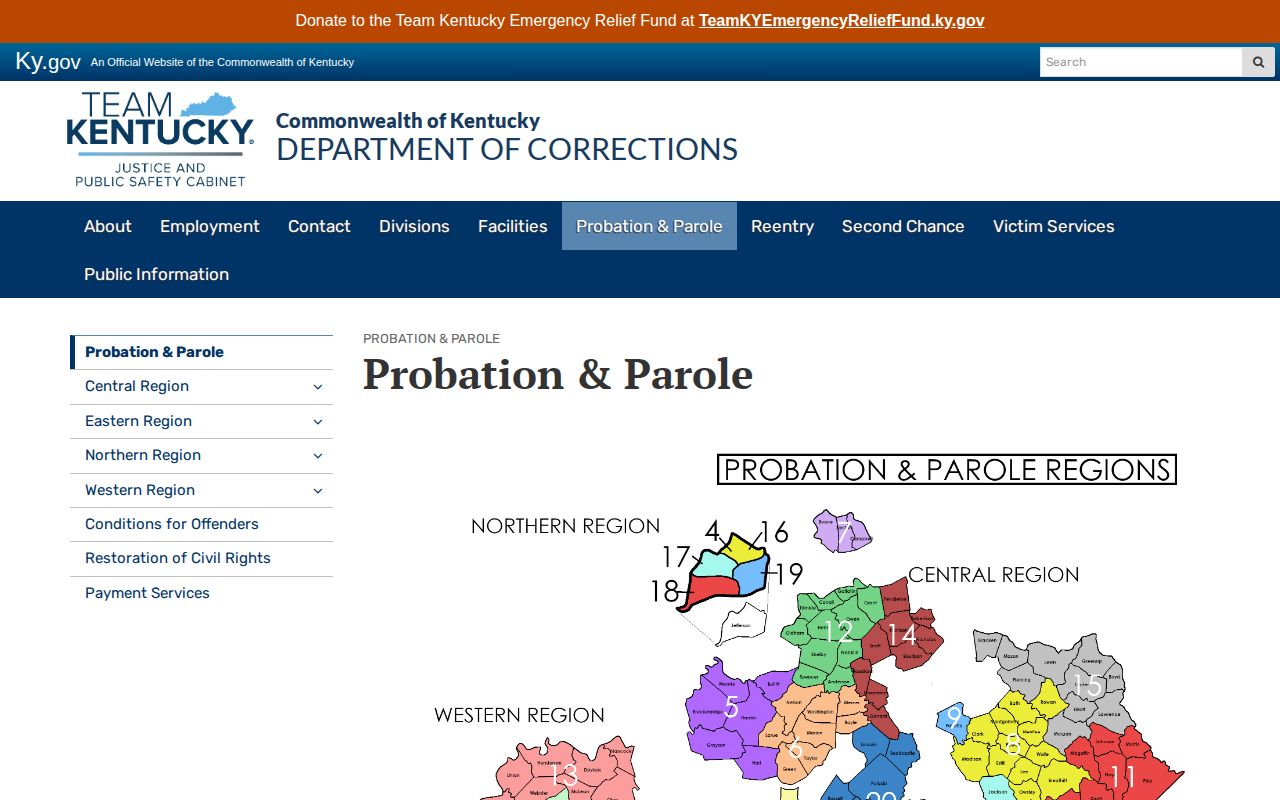
The image supports agency identity, while the District 7 record supplies the Campbell County contact.
Campbell County Absconder Status
An absconder notation means the supervised person failed to remain in required contact or location. It is not final discharge. It also does not, by itself, prove a new arrest or present jail custody. No official public Campbell County warrant or absconder name list was verified.
Check the exact KOOL status and date. If a warrant question remains, use the issuing court, Campbell County Sheriff, or DOC supervision authority. VINE can report custody changes when a participating jail or correctional facility records them, but it is not a warrant database and does not replace the supervision order.
Common supervision conditions may address reporting, travel, programs, or other case-specific duties, but the actual signed order controls. Do not assume one person's terms apply to another. A revocation can return a person to custody, while a violation allegation may remain unresolved until the responsible authority acts.
Campbell County Parole Hearing Checks
The Kentucky Parole Board schedule page publishes monthly schedules and eligibility lists. Hearings are conducted weekly, begin at 8:30 a.m. Eastern, and the page is updated each Monday morning. An eligibility list may show a name, DOC number, location, and eligibility month. A hearing can occur up to two months before actual eligibility.
Listing does not mean parole was granted or release occurred. Members of the public may request videoconference observation by emailing Paroleboard@ky.gov or ask the institution about in-person attendance. File reviews are not observable. No universal public statewide name-searchable decisions database was verified.
| Stage | What proves it |
|---|---|
| Eligibility or scheduled review | Board eligibility list and schedule |
| Grant, denial, deferment, or serve-out | Board decision or responsible record |
| Physical release | DOC or facility release record |
| Community supervision | KOOL and parole order |
| Final discharge | Final Board or DOC discharge record |
KRS 439.340 places parole authority with the Board. Eligibility depends on sentence and statutory rules. The parole eligibility regulation contains the general schedule and many overrides, as shown in the official capture below.
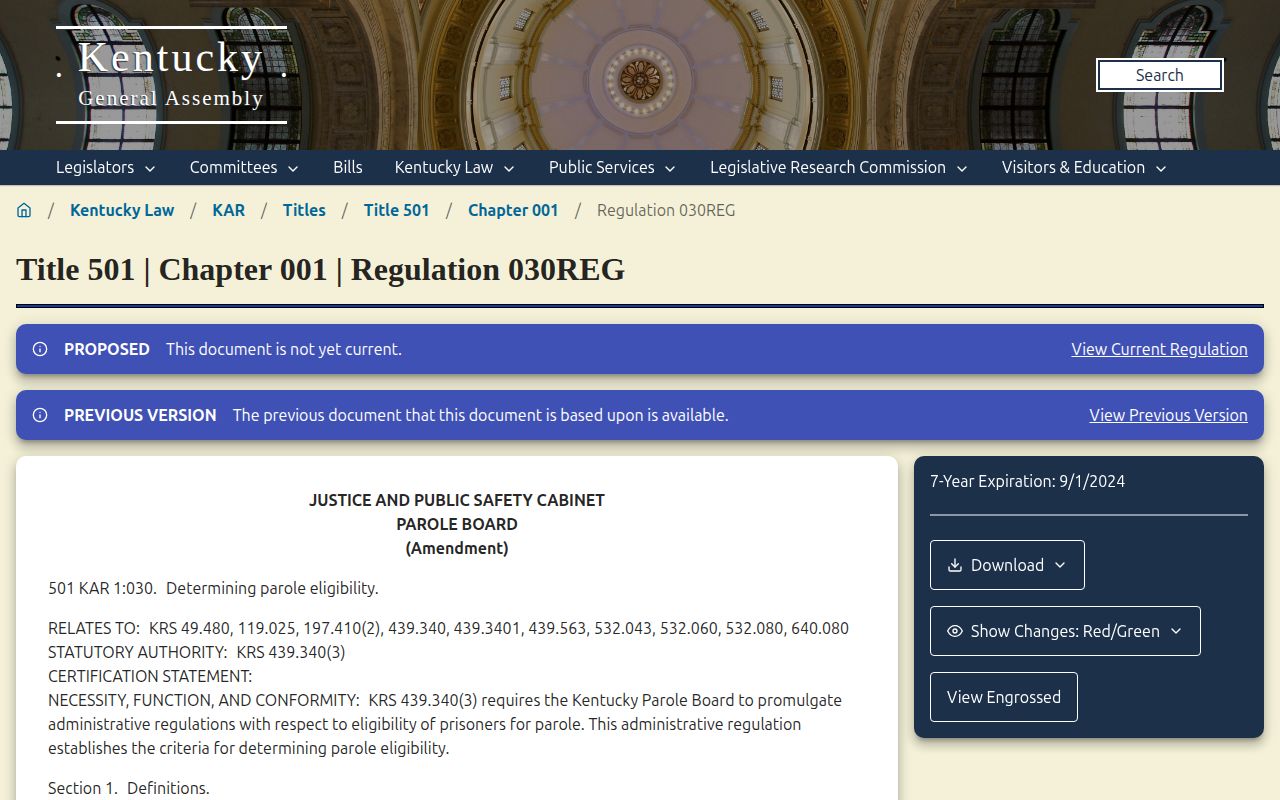
The regulation is evidence of eligibility rules, not a finding that any named person received parole.
Campbell County Work Release Status
The Campbell County Work Release Program generally serves sentenced inmates and has a specific approval chain. For felony participation, paperwork may move from the offender or outside sponsor through the County Attorney, Jailer or designee, and Circuit Judge. An approved participant can leave secure confinement for authorized work and return.
That temporary movement is not parole, probation, or final discharge. The person remains in program custody until an actual release or transfer record says otherwise. For a state-sentenced participant, compare CCDC status with KOOL. For the final event, seek the jail or DOC release record and the court judgment where relevant.
The official work-release program documents the local approval route. Post-prison navigation belongs with District 7 and Kentucky DOC Reentry Services, not the work-release movement record.
Campbell County Property After Release
CCDC property release uses written consent and an appointment. The inmate gives written permission naming a pickup person. The property clerk then calls to schedule the visit, and the named person presents valid state identification in the main-jail visitation lobby. Appointments run Monday through Friday, 9 a.m. to 3 p.m. Unscheduled arrivals are not accepted.
This property process does not establish parole, probation, or discharge. It is a separate release-related task. The CCDC FAQ supplies the official procedure. A person trying to prove supervision status still needs KOOL and the governing order.
Campbell County Supervision Discharge
Supervision ends through a final action by the authority that controls it. For probation, seek the Campbell court's signed order. For parole or mandatory reentry supervision, seek the responsible Board or DOC discharge record. A past projected release date, an old probation judgment, or absence from JailTracker does not prove that supervision ended.
Mandatory reentry supervision under KRS 439.3406 is legally release on parole for eligible inmates placed before projected sentence completion. It is not sentence commutation. Distinguish the prison exit date, supervision start, later supervision end, and final discharge.
When sources conflict, use the Campbell County release records for physical-custody evidence and the supervision authority for legal status. Ask the custodian to correct a stale public entry rather than assuming it supersedes a dated final order.
Access Campbell County Supervision Records
Public lookup data is only the starting layer. For probation, request the Campbell court docket and the signed judgment, probation order, revocation order, amendment, or final discharge that answers the specific question. District Court generally handles misdemeanors, violations, preliminary felony matters, and many early bond issues. Circuit Court handles indicted felony cases and final felony judgments. The clerk's office is at 330 York Street in Newport and uses 859-292-6314, with press 1 for District Court and press 2 for Circuit Court.
For parole, identify the DOC number and ask the Kentucky Parole Board or DOC for the decision, conditions, release record, or final discharge needed. Kentucky corrections records have limits under KRS 197.025, including security protections and restrictions on named-inmate inspection. A focused request for status, dates, and the controlling order is more precise than seeking a complete institutional file.
Do not merge custody, court, and supervision records. CCDC documents when a person physically left the county facility. The court documents a judicial sentence or probation action. DOC and the Board document state custody, parole, mandatory reentry supervision, and discharge. Keeping those roles separate prevents a jail release from being mistaken for the end of all legal control.
Read Campbell County Parole Actions
A Board outcome can be a grant or recommendation, denial with deferment, serve-out, file review, revocation, or mandatory reentry supervision order. A grant remains conditional. It is not a pardon, final discharge, or proof of the date the person left a facility. Release processing and another detainer may affect the next custody event.
Eligibility rules vary by sentence, offense, and governing statute. Certain nonviolent Class D aggregate sentences of one to five years have review after 15 percent or two months, whichever is longer, under KRS 439.340. Other cases follow the statutes and regulation, with special rules for violent offenses and other categories. Never apply a single percentage or timetable to every Campbell County offender.
After a scheduled review, check KOOL for the later custody or supervision status and obtain the decision when the exact result matters. Then use the DOC release record to establish physical departure. This sequence distinguishes an expected event from one that actually occurred.
Public Record Search
Sponsored Results